Addition and Subtraction Game
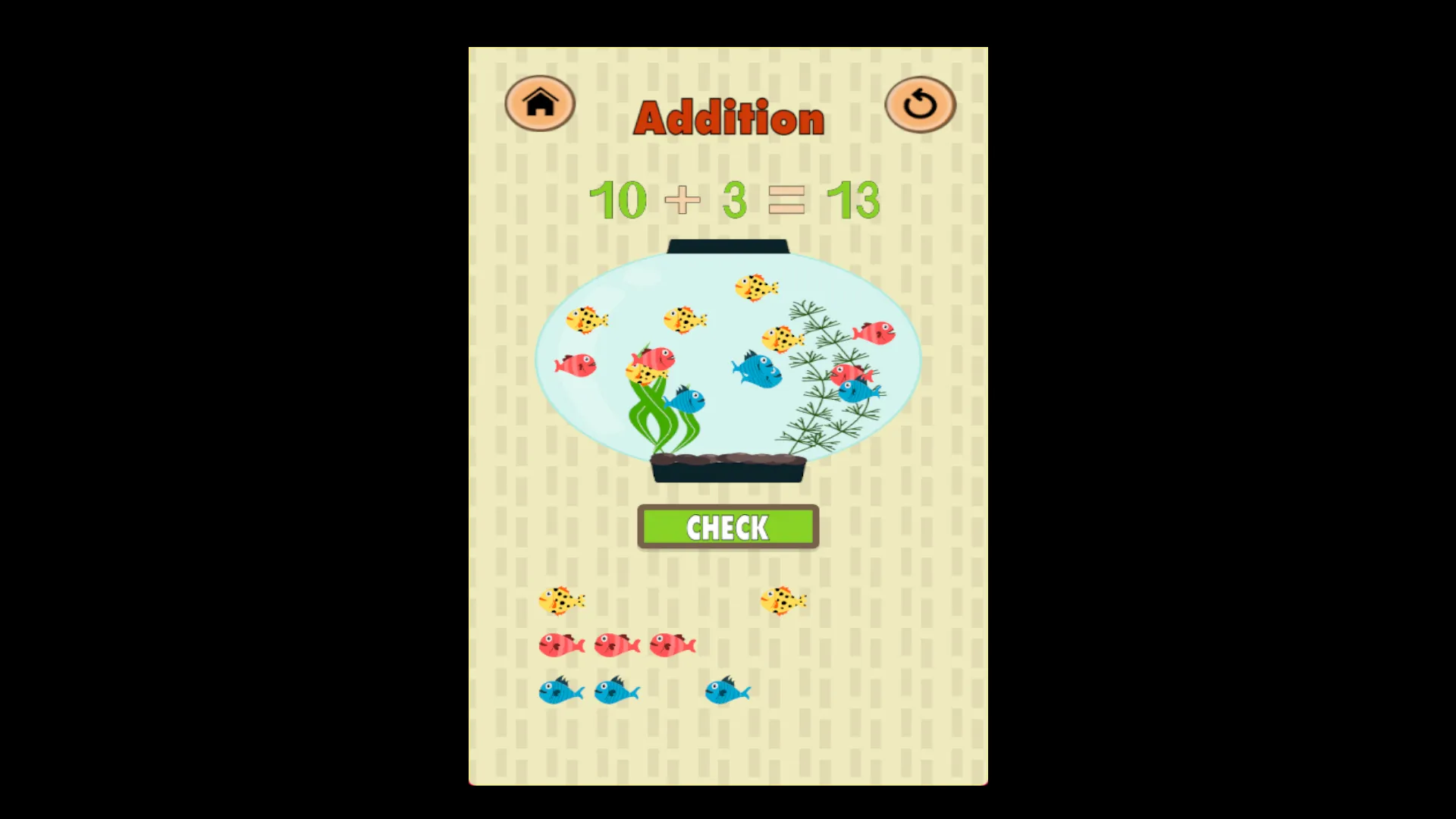
Addition and Subtraction Game is a 2D educational project developed in Unity as a freelance client assignment. The game teaches children basic arithmetic through interactive visual counting mechanics. The original English version was built in Construct 3. The project was later fully recreated in Unity with restructured gameplay systems, enhanced interaction logic, and bilingual support (English and Arabic). Players select their preferred language, choose between addition or subtraction modes, and interact with animated fish to represent numeric answers. Each fish corresponds to one unit, and players dynamically add or remove fish before validating their solution.
Key Features
- Addition and subtraction gameplay systems.
- Visual numeric representation using animated fish entities.
- Real-time answer validation logic.
- Bilingual UI support (English & Arabic).
- Score calculation and progression tracking.
- Cross-platform deployment for PC, Android, and WebGL.
Screenshots
Challenges & Solutions
Challenge
Rebuilding Construct-based arithmetic logic into scalable Unity systems.
Solution
Implemented modular equation handling and result validation components separated from UI and animation layers.
Challenge
Creating a clear visual mapping between fish count and numeric result.
Solution
Developed a container tracking system that dynamically updates result values based on active fish objects.
Challenge
Designing a flexible arithmetic validation system adaptable to both addition and subtraction modes.
Solution
Implemented a modular evaluation engine capable of dynamically interpreting operation types and validating player input while maintaining a unified gameplay loop.
Project Overview
Technologies
Development Process
The project centered on rebuilding the original concept into a modular Unity-based system designed for clarity and scalability. Core arithmetic evaluation logic and container tracking systems were architected first to establish a stable and extensible gameplay foundation. Once the core loop was validated, focus shifted toward interaction refinement, animation integration, and bilingual support. Special care was taken to ensure smooth transitions between English and Arabic interfaces while maintaining gameplay consistency. The final phase emphasized scoring system integration, visual polish, performance optimization, and thorough cross-platform testing across PC, Android, and WebGL to guarantee stable and responsive behavior.
Timeline
Phase 1 (Weeks 1–3)
Core arithmetic architecture, container tracking systems, and primary gameplay loop implementation.
Phase 2 (Weeks 4–6)
Interaction refinement, animation integration, and scoring system development.
Phase 3 (Weeks 7–8)
Bilingual localization, UI adjustments, optimization, testing, and deployment.